
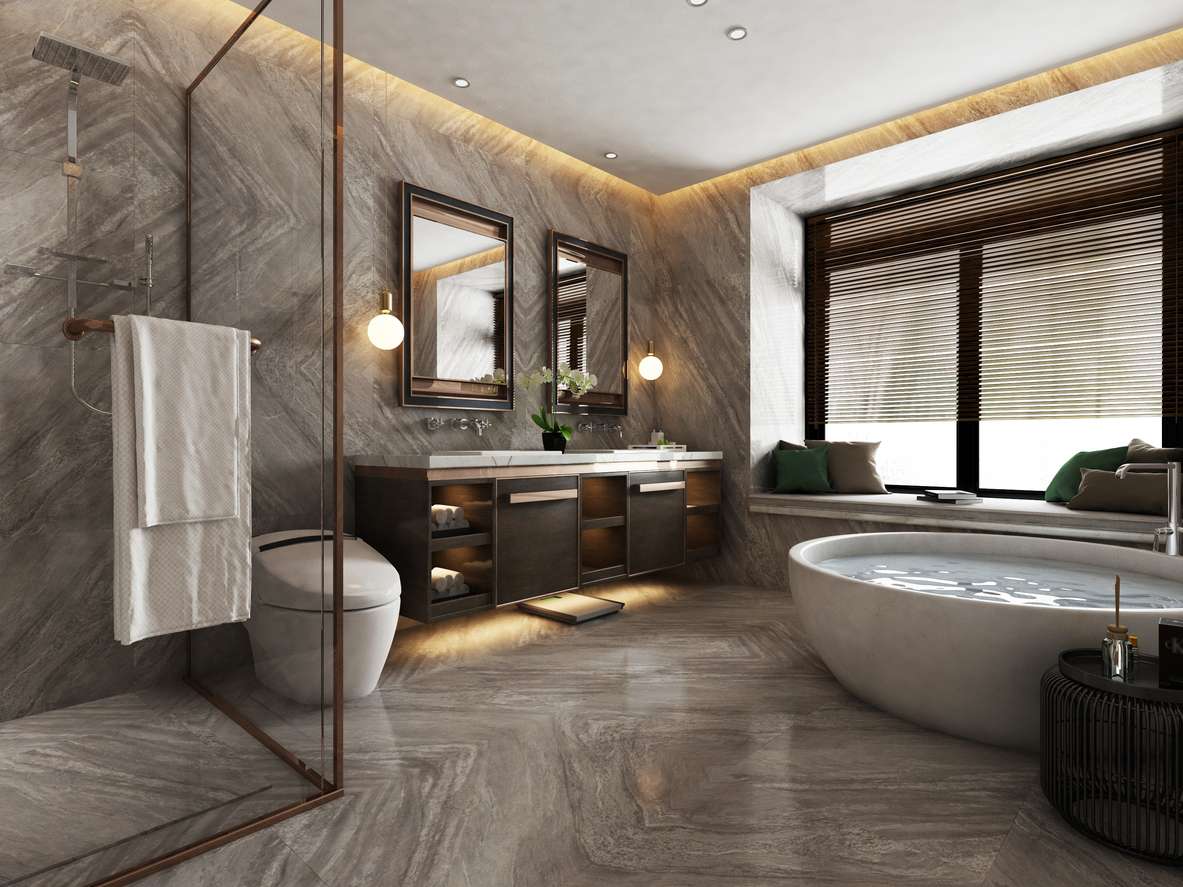
When you live in Eagle, you aren’t just remodeling a bathroom — you are upgrading an asset in one of the most robust housing markets in the Mountain West. If you’re earlier in your research, our bathroom remodeling in Boise and Eagle neighborhood design guide is a useful starting point for understanding how location shapes design decisions across the Treasure Valley. But distinctive homes require distinctive planning. Before you fall in love with a finish, it pays to understand what a bathroom remodel at this level actually involves — and what separates a project that holds up from one that quietly disappoints.
The homes here are large — averaging 2,759 square feet for single-family residences, according to Ada County data. The owners tend to stay put, with an owner-occupancy rate of 84.1% (U.S. Census Bureau, 2020–2024). And the budgets reflect both. That context shapes every decision in a high-end primary-bath project, from the structural layout to the final polished nickel fixture.
Why Eagle Homeowners Remodel Instead of Move
For years, the standard advice for homeowners wanting a better primary suite was simply to “trade up.” In the Boise area, that math has fundamentally changed. When for-sale inventory in the Boise metro fell to just 0.3 months of supply (HUD Boise City Housing Market Analysis), moving stopped being a realistic option for most homeowners — even affluent ones. As a result, the average Boise-area home sales price rose nearly 13% to $375,200 in the same period. Trading your current home for a comparable or better one became a financial and logistical obstacle course.
Eagle’s housing landscape is even more specific. The median home value has climbed to $772,900 (U.S. Census Bureau, 2020–2024), and more than half the housing stock was built between 2000 and 2018. This means many Eagle homes sit in a unique position: they are neither new enough to feel cutting-edge nor old enough to need wholesale structural work. They are structurally sound but stylistically tired. In short, they are ready for an evolution.
“When Boise-area inventory fell to 0.3 months of supply, upgrading your existing home became the smarter path — not the consolation prize.” — HUD Boise City HMA
The 84.1% owner-occupancy rate in Eagle reinforces this mindset. People here are not passing through. They have invested in their community, their streets, and their square footage. Consequently, a primary-bath renovation in that context is not a transaction to flip a property — it is an investment in a home they plan to live in for years.
Remodeling also gives you something the market cannot: control. You choose the layout, the materials, the fixtures, and the contractor. You don’t inherit someone else’s decisions. That matters even more when the budget is serious.
What a $30K, $50K, and $75K+ Bathroom Remodel Actually Buys in Eagle
Budget conversations are where most bathroom remodel articles fall apart. They either give you a national median — roughly $15,000, per the 2024 Houzz Bathroom Trends Study (up 11% year over year) — that has absolutely nothing to do with a large primary-bath renovation, or they throw out a “luxury” number with no breakdown. Let’s do this properly.
Ada County’s own building permit data is instructive: the median declared value for bath-related permits was $38,479, with 38.7% of permits at $50,000 or above and 16.1% reaching $100,000 or more. High-budget bathroom work is not theoretical in this market. It is already happening.
At $30K: Focused Premium Refresh
At this level, you are not doing a full gut renovation. Instead, you are making targeted, high-visibility upgrades: a new vanity and quartz countertop, refreshed tile, updated plumbing fixtures, improved lighting, and possibly a frameless shower door replacement. The bones of the room stay. The feel changes completely.
This is a smart tier when the layout works, the plumbing is well-positioned, and what you really want is to step into a bathroom that no longer reads as builder-grade. Most of the heavy costs — moving walls, relocating drains, structural subfloor work — are avoided entirely.
At $50K: Full Transformation
Here the scope opens up considerably. You can rethink the layout. You can demo the shower and build it right, with large-format tile, a recessed niche, multiple showerheads, and a frameless glass enclosure (75% of renovated bathrooms now include frameless doors, per the 2025 Houzz Bathroom Trends Study). A new freestanding soaking tub becomes realistic. The vanity is custom or semi-custom. Heated floors are in range.
At $50,000, you are making decisions that will define how the room feels for the next 15 years. The upgrades are visible, structural, and durable.
At $75K+: Spa-Level Primary Bath
The top 10% of bathroom projects nationally reached $60,000 — and those projects involving a bathroom over 100 square feet with a full shower upgrade hit $70,000 (2025 Houzz Bathroom Trends Study). In Eagle’s primary bath category, $75,000 and above is not extravagant. It is market-consistent for a home in the $500K+ range.
At this tier, you are making architectural decisions: relocated plumbing, possibly a wet room design, steam shower, radiant heated floors, hand-selected stone or slab-matched surfaces, custom cabinetry, integrated lighting design, and smart features like mirror defoggers or programmable thermostatic shower controls. Two Rivers and Banbury Meadows projects frequently reach this tier — and earn it.
“In Ada County, 38.7% of bathroom building permits in 2019 were declared at $50,000 or above. The high-budget remodel market here is real.” — Ada County Development Services
The Features That Matter Most in a Luxury Bathroom
At the $50K–$75K+ level, the challenge is not spending money — it is spending it in the right order. Some features create a permanent return in daily quality of life. Others are beautiful in a showroom and underperform in actual use. Here is how to think about it.
Start With the Shower
The shower is where this conversation belongs. In survey after survey, it ranks as the single most in-demand bathroom feature. Furthermore, 75% of homeowners who renovated chose frameless shower doors, making clear glass essentially the new baseline for premium bathrooms (2025 Houzz Bathroom Trends Study).
Invest here first. A large, well-built shower with proper waterproofing, quality tile work, excellent fixtures, and a functional layout will outlast almost every other upgrade. It is also the feature that communicates luxury to guests and buyers more immediately than anything else in the room. Our guide to walk-in shower ideas for a bathroom remodel in Boise covers the design and spec decisions in detail.
A multi-function showerhead, a recessed niche (not an afterthought shelf), a bench seat, and a linear drain all elevate function and feel simultaneously. None of them require a wet room budget.
When Heated Floors Are Worth It
About 20% of renovated bathrooms now include radiant heated flooring (2025 Houzz Bathroom Trends Study). That number is selective enough to feel premium, but mainstream enough to be a reasonable line item in any serious remodel budget.
In Eagle, this is an easy call. Idaho winters are real. Stepping onto a cold tile floor at 6 a.m. is not a neutral experience. Radiant heat under your tile costs roughly $10–$15 per square foot for the system, and in most primary baths the total addition to the project budget is modest relative to the daily comfort return.
The real question is whether your subfloor and electrical panel support it. That is a contractor conversation — but in homes built in the 2000s and 2010s, it usually is not an obstacle.
Quartz, Tile, and Smart Luxury Material Choices
Engineered quartz was chosen by 45% of bathroom renovators as their countertop material (2025 Houzz Bathroom Trends Study). The reason is simple: it performs. It does not require sealing, it resists Treasure Valley hard water, and it holds its appearance for decades. For vanity tops and tub decks, it remains the safest, most resale-stable choice at any price point.
For tile, large-format porcelain in a subtle stone look, installed with tight grout joints and precision, outperforms expensive natural stone that is poorly laid every single time. You do not need marble everywhere. You need the right material, in the right place, installed by someone who knows what they are doing.
“45% of bathroom renovators chose engineered quartz for countertops — durable, hard-water resistant, and consistently strong on resale.” — 2025 Houzz Bathroom Trends Study
Is a Freestanding Tub Right for Your Eagle Bathroom?
Few decisions in a luxury bathroom remodel generate more enthusiasm — or more regret — than the freestanding tub. It photographs beautifully. It signals spa-level ambition. And in the wrong room, it becomes an expensive floor ornament that nobody uses and everybody cleans around.
This section draws from our complete freestanding tub renovation guide and focuses on the decisions specific to Eagle homeowners at the $60K+ tier.
When a Freestanding Tub Makes Sense
A freestanding tub earns its place when the primary bathroom is genuinely large (Eagle’s average single-family home runs 2,759 sq ft, and primary baths in those homes tend to have room), the homeowner actually bathes regularly, the shower is separate and fully capable, and the floor can support the weight when filled. Most floors can — a contractor will verify.
The aesthetic case is real. In a room with high ceilings, natural stone or large-format tile, and a window positioned to create natural light, a sculptural soaking tub reads as the centerpiece it is meant to be.
When It Becomes a Costly Mistake
The tub loses the argument in several situations. It replaces the primary shower rather than supplementing it — almost always the wrong trade. The floor plan requires awkward positioning that disrupts circulation. The plumbing supply lines would need to run an unreasonable distance. Or, simply, the homeowner is honest enough to admit they prefer showers.
The cleaning argument is not small, either. A freestanding tub requires access on all sides, which means mopping around and under it. In tight primary baths, that is a daily nuisance.
Resale Considerations
Resale implications are more nuanced than the “tubs always sell houses” myth. Regional Cost vs. Value data from the Pacific Northwest shows that well-scoped midrange bath remodels can recoup a substantial share of their cost — but upscale remodels skew toward lifestyle value rather than pure resale math. In Eagle’s market, a freestanding tub in the right bathroom adds to the luxury aesthetic and attracts the right buyer. In the wrong configuration, it becomes a liability.
How to Future-Proof the Bathroom Without Making It Feel Clinical
This is where the conversation about aging-in-place usually goes wrong. It either gets skipped entirely — “we’ll deal with that later” — or it gets treated as a medical accommodation. Neither approach serves an affluent homeowner in their late 40s or early 60s who is investing $60,000 or more in a room they intend to use for decades.
What the Data Actually Shows
According to the U.S. Census Bureau’s Aging-Ready Homes Report, just 40% of U.S. homes have even the most basic aging-ready features — a step-free entryway and a bedroom and full bathroom on the first floor. More advanced upgrades like grab bars, curbless showers, and built-in seating remain uncommon even in higher-end homes. As a result, most houses — including well-maintained, high-value Eagle homes — are considerably less ready for long-term comfortable use than their owners assume.
The Design-Forward Approach
The design-forward answer is to build these features in from the start — not as accommodations, but as quality-of-life upgrades that happen to compound in value over time. If you’re also weighing whether an open layout makes sense for your primary bath, our guide to open concept bathroom remodeling in Boise walks through when that decision works and when it doesn’t.
A curbless shower entry, for example, is a premium design choice that also eliminates the most common trip hazard in the shower. A built-in teak bench is luxurious today and functional for decades. Grab support integrated into the tile pattern at the shower entry does not read as safety equipment — it reads as thoughtful design.
68% of homeowners in the 2025 Houzz Bathroom Trends Study reported considering special needs in their bathroom projects. Future-proofing is mainstream — it just doesn’t have to look like it. Moreover, 64% of renovated bathrooms in the same study incorporated grab bars, which suggests the conversation has already shifted. The question is whether your design integrates them elegantly or as an afterthought.
The fastest-growing age cohort in the Boise HMA is residents 65 and older, growing at 4.6% annually (HUD Boise City CHMA). That demographic context is not abstract — it describes where Eagle is heading and who the market will increasingly serve. Build the right room now. You will be glad you did.
“Just 40% of U.S. homes have even the most basic aging-ready features. A thoughtful luxury remodel is a rare opportunity to be ahead of that curve — without any clinical compromise.” — U.S. Census Bureau, Aging-Ready Homes Report (2023)
How to Choose a Bathroom Remodel Contractor in Eagle
At $60,000 and above, 83% of homeowners rely on professionals to manage their bathroom renovation (2024 Houzz Bathroom Trends Study). That number is not surprising — the scope is too complex, the coordination too demanding, and the margin for error too expensive to manage without expertise.
What is less obvious is how to distinguish a capable contractor from one who simply has a good website.
What Local Fluency Actually Means
In Eagle specifically, you want someone who has worked in this neighborhood profile — who understands the construction quality of 2000s–2010s homes, has relationships with local permit offices, and has handled the subfloor and plumbing configurations common to Treasure Valley builds. General competence is not enough. Local fluency matters.
A well-run project also means scope clarity up front. A good contractor walks you through a realistic budget before any contract is signed — because well-defined allowances reduce uncertainty more than waiting for material prices to fall.
What Affluent Homeowners Should Ask Before Signing
- Does the contractor pull permits and manage inspections directly, or subcontract that responsibility?
- Can they show completed projects in Eagle or the Treasure Valley — not just online galleries, but actual addresses you can see?
- How do they handle allowances? Are material costs itemized, or bundled in ways that obscure overruns?
- What is their process when the project reveals unexpected conditions — old plumbing, wet board behind tile, undersized electrical?
- Who is on-site daily, and how is progress communicated?
- What does their warranty cover, and for how long?
The Pristine Kitchen & Bath Eagle service page reflects what this looks like in practice — a local team that works in these neighborhoods, knows these homes, and operates with a process built for premium projects.
FAQ: Bathroom Remodel Costs, Timelines, Freestanding Tubs, and Value
Q: How much does a bathroom remodel cost in Eagle, Idaho?
The range is wide because the scope varies so much. A focused premium refresh — new vanity, fixtures, frameless glass, refreshed tile — typically runs $25,000–$35,000. A full transformation with a new shower build, custom cabinetry, and a soaking tub usually falls in the $45,000–$65,000 range. A spa-level primary bath with relocated plumbing, heated floors, custom stonework, and steam features starts at $75,000 and can exceed $100,000 for large spaces. Ada County permit data shows that 38.7% of local bath permits were declared at $50,000 or above, so high-budget work is not unusual in this market.
Q: Is $75,000 too much to spend on a bathroom remodel?
Not for a large primary bath in a $500K+ Eagle home. The top 10% of bathroom projects nationally reached $60,000 in the 2025 Houzz Bathroom Trends Study, and for bathrooms over 100 sq ft with a full shower upgrade, that number climbs to $70,000. In Eagle, where the average single-family home is 2,759 sq ft and the median home value has climbed to $772,900 (U.S. Census Bureau, 2020–2024), a $75K primary-bath renovation is proportionate to the asset. The more relevant question is: does the scope justify the investment?
Q: Are freestanding tubs worth it?
When they’re right for the room, yes. When they’re not, they’re expensive to install and tedious to maintain. The key factors: Is the bathroom large enough to give the tub breathing room? Does the homeowner actually use a tub regularly? Is the shower entirely separate and fully functional? If all three answers are yes, a freestanding tub can elevate the space significantly. If the layout is tight or the tub replaces the primary shower, it usually becomes a regret.
Q: Do freestanding tubs hurt resale value?
Rarely, in the right context. In a large, well-designed primary bath where a quality shower already exists, a freestanding tub adds to the luxury aesthetic that Eagle buyers expect. It becomes a liability when it crowds the space or compromises shower access. The 2024 Cost vs. Value data from the Pacific Northwest shows that well-scoped bath remodels can recoup a meaningful share of cost — but upscale renovations are primarily lifestyle investments, not pure financial ones.
Q: How long does a bathroom remodel take in Eagle?
A focused refresh runs 3–5 weeks. A full gut renovation — demo, new plumbing rough-in, tile, cabinetry, glass — typically takes 6–10 weeks, sometimes longer for custom or special-order items. Steam systems, radiant heat, and permit-intensive scope can add time. The single biggest variable is lead time on materials: custom tile, specialty glass, and freestanding fixtures can have 6–12 week delivery windows. Sequencing those orders early is one of the clearest signs of a well-run project.
Q: Should I remodel instead of buying a different home?
For most Eagle homeowners, yes — especially in the current market. Boise-area inventory has been severely constrained, and home prices rose sharply over the past several years. When you factor in transaction costs, moving costs, the stress of competing for inventory, and the reality that you’d likely be trading one set of compromises for another, remodeling the home you already love is often the better path. You already know the neighborhood. You’ve already absorbed the carrying costs. And a well-designed primary bath can transform how the house feels every single day.
Ready to Plan Your Eagle Bathroom Remodel?
If you have read this far, you are not looking for a quick estimate — you are looking for a contractor who will help you think through the project before committing to it. That is the right instinct.
The best bathroom remodels in Eagle start with a real conversation about how you use the space, what is driving the project, and what you want to feel when you walk in every morning. Budget follows scope. Scope follows goals.
Pristine Kitchen & Bath has worked in Eagle homes across the price spectrum — from focused refreshes to full spa-level primary-bath transformations. Our bathroom remodel services are built for projects that deserve to be done once and done right.


